
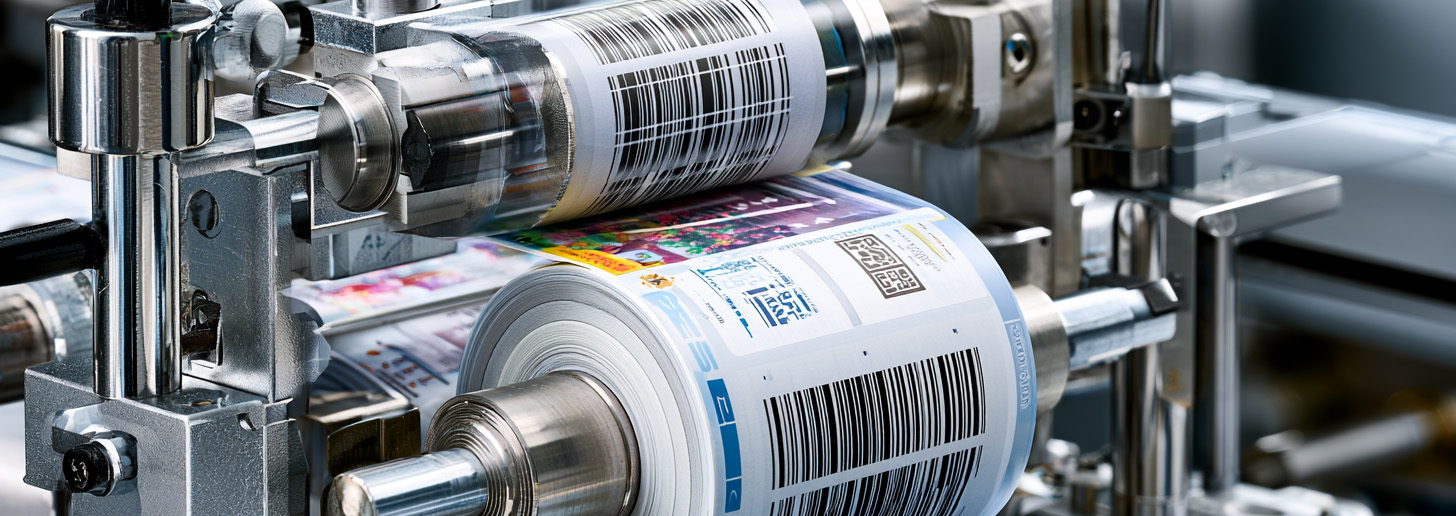
Benefits of Prime RFID Labels and Design Considerations
Retail requirements around RFID tagging are accelerating. What started as a mandate for select product categories has quickly expanded across major retail channels, pushing suppliers and brand owners to rethink how RFID compliance fits into their overall packaging strategy—without adding cost or complexity.
A common approach has been to apply a plain RFID label alongside the primary product label. While functional, this method adds an extra step to the application process and can compromise the package’s visual consistency. Prime RFID labels eliminate that trade-off by embedding the RFID inlay directly within the primary label.
The result is a single, purpose-built label that handles both brand presentation and RFID compliance simultaneously. Your customers can reduce labor time, cut down on secondary label inventory, and present a cleaner, more consistent product on the shelf—without sacrificing design quality or scan performance.
Major retailers including Walmart, Target, and Amazon have already rolled out RFID mandates across key product categories, with more programs expanding each year. Understanding how prime RFID labels meet these requirements—and the design decisions that go into producing them—is increasingly important for distributors and suppliers who want to stay ahead of compliance deadlines.
RFID Fundamentals
What is a Prime RFID Label?
A prime RFID label integrates a high-quality printed label with an embedded RFID inlay, delivering brand-forward design and tag functionality in one cohesive package. Rather than treating RFID as an add-on, this approach makes the inlay a built-in part of the label structure from the start.
For customers managing large label programs, this consolidation creates real operational advantages. There’s no need to manage two separate label SKUs, run two application processes, or coordinate across different suppliers. Everything ships, stores, and applies as a single unit.
From a cost standpoint, the efficiency gains compound quickly. Eliminating a secondary RFID label removes both the material cost and the labor associated with applying it. Over high-volume programs, that translates to meaningful savings—while actually improving the finished look of the product on shelf.
Prime RFID labels are also highly customizable. Because the inlay is embedded during the label manufacturing process, the full face of the label remains available for graphics, text, and compliance marks. This gives brands maximum flexibility to maintain their visual identity while meeting RFID requirements without compromise.
Key Advantages
RFID Label Benefits
Here are some of the core performance advantages RFID technology delivers across industries.
Wide Scan Radius
Scan range is one of the most significant performance differences between RFID and legacy barcode systems. Traditional barcodes require a scanner positioned close to the label with clear line of sight—conditions that slow workflows and add handling requirements. RFID operates on radio frequency, enabling reads at much greater distances and through a variety of packaging materials.
For inventory-intensive environments, this range advantage changes the entire dynamic of receiving or cycle count operations. Workers can capture multiple items simultaneously without touching or repositioning them, dramatically reducing the time required to process a shipment or complete a floor audit.
Read accuracy is equally compelling. RFID systems consistently achieve read rates above 99%, compared to the periodic misreads that occur in barcode workflows—directly reducing order errors and costly downstream corrections.
Real-Time Data and Tracking
Beyond range and accuracy, RFID delivers a speed advantage that transforms how inventory data is captured and used. Labels can be read in milliseconds, enabling continuous, automatic data collection that keeps location and stock information up to date throughout the day—without requiring staff to manually initiate each scan.
The automation factor also removes a significant source of variability from the process. Since RFID reads don’t depend on human positioning or line-of-sight conditions, the data collected is far more consistent. Fewer manual touchpoints mean fewer transcription errors, more reliable stock counts, and a leaner process from the warehouse floor to the point of sale.
Label Quality
Prime Label Benefits
High-quality printed labels do more than convey product information—they shape how a customer perceives a brand at the moment of decision. Prime labels are manufactured to the highest print standards, producing sharp graphics and accurate color reproduction that elevate any product’s shelf presence. Here’s how that translates into value for your customers.
Branding
A well-executed label is often the first brand touchpoint a shopper encounters on the shelf. Prime printing allows companies to represent their brand identity with full fidelity—precise colors, clean typography, and a professional finish that holds up under retail lighting and close inspection alike.
Distinguished Print Quality
Prime print processes—including flexographic, digital, and combination printing—produce crisp detail and consistent color across high-volume runs. Labels look as good on the thousandth unit as they do on the first, ensuring products make a strong impression at any production scale.
Durability & Compliance Readiness
Prime RFID labels can be specified with materials designed to withstand specific handling, environmental, or retail conditions. The built-in RFID inlay also ensures the label meets retailer mandate requirements from day one, with no secondary tagging step required at distribution.
Design Guidelines
Considerations When Designing Prime RFID Labels
To meet retail mandates and produce the most effective label design, here are the key factors your customers should plan for from the outset.
Label Facestock Design
Most major retailer RFID mandates require the EPC logo to appear somewhere on the visible face of the label. It can be scaled to fit the design without dominating it, but it must be present and fully visible. Flagging this early in the design process prevents costly artwork revisions—customers who plan for it from day one save significant time.
RFID Inlay Placement
Where the inlay sits within the label—and where that label is applied on the product—both affect read performance. Radio frequency signals can be disrupted by metal surfaces, which can reflect or absorb the signal before it reaches the reader. Products intended for metal shelving or metallic packaging should be evaluated carefully, and label positioning may need adjustment to ensure consistent scan results.
Label and Inlay Sizing
RFID inlays are produced in standardized dimensions that cannot be modified after manufacturing—there’s no trimming or reshaping to make an inlay fit a smaller footprint. Early coordination between label size and inlay size is essential. If the label design or packaging format changes during development, inlay compatibility should be re-evaluated before production to avoid reprints or tooling changes.
Label Materials
Paper and film-based synthetics like polypropylene and polyester tend to be RF-neutral and work reliably across most standard applications. However, when products will be placed on or near metal surfaces, standard inlay construction may not perform adequately. On-metal RFID inlay constructions are available for these situations and should be specified during the planning phase, not treated as an afterthought.

Frequently Asked Questions
What is the difference between a prime RFID label and a standard RFID label?
A standard RFID label is typically a plain, functional tag applied separately from the primary product label. A prime RFID label integrates the RFID inlay directly into the primary printed label—the one your customers already see on the product. This eliminates the need for two separate labels and combines branding and compliance functionality in a single, professionally printed solution. Looking for RFID printing and encoding hardware? Browse our printers, software and supplies for the full BCS lineup.
Do prime RFID labels comply with major retailer mandates?
Yes. Prime RFID labels are designed to meet the requirements of major retailer RFID programs, including mandates from Walmart, Target, and Amazon. When designed correctly—with the required EPC logo placement, appropriate inlay positioning, and compatible materials—a prime RFID label can satisfy compliance requirements right out of the applicator, with no secondary tagging step at the distribution center. Not sure if your label design meets current mandate requirements? Contact us at sales@bizcomsolutions.net or call 908.429.8574 and our RFID team will walk you through it.
How do I get started with a prime RFID label program for my customers?
The best starting point is understanding your customers’ label dimensions, volume requirements, and the retailer mandates they need to meet. From there, the BCS team can help identify the right inlay type, facestock, and print process for your application. Reach out to our RFID specialists at sales@bizcomsolutions.net or call 908.429.8574—we’ll help you build a program that’s compliant, cost-effective, and ready to scale.
Ready to build a prime RFID label program?
If you are looking for more information on Prime RFID Labels and how you can benefit from combining performance, efficiency, and cost savings into a single solution, we’re here to help. Reach out to one of our RFID experts at BCS to learn how BCS can support your labeling needs from concept through implementation.
TALK TO OUR EXPERTS TODAY sales@bizcomsolutions.net | 908.429.8574